
In-depth analysis of Piti by a cosmetic physician
Review/analysis of ingredients: an excellent body lotion for dry skin and elderly skin from the brand Piti Dry Skin Expert
Hello to all the seniors, juniors, friends, and everyone in the Jeban community. Dry skin is another issue that bothers many people. Dry skin isn’t necessarily a good thing, because when the skin is dry it can trigger various kinds of inflammation, leading to itching and redness—and if we scratch, it increases the risk of infection.
Even more concerning. One of the easiest ways to care for dry skin is to apply a moisturizer to replenish water and lipids back into the skin. Today I’d like to bring up an interesting moisturizing lotion made by a Thai brand, Piti Dry Skin Expert. The idea started from the brand owner’s desire to create a lotion to care for their father and mother, who had very dry skin that affected their daily quality of life. After their parents used it and felt better and happier, the brand wanted to pass on the love and happiness from using this product to everyone. Piti is an interesting lotion because, besides having well-formulated ingredients, the feel and texture are also done very well. It’s also blended with a real essential-oil scent, offering aromatherapy benefits that help you relax while using it.
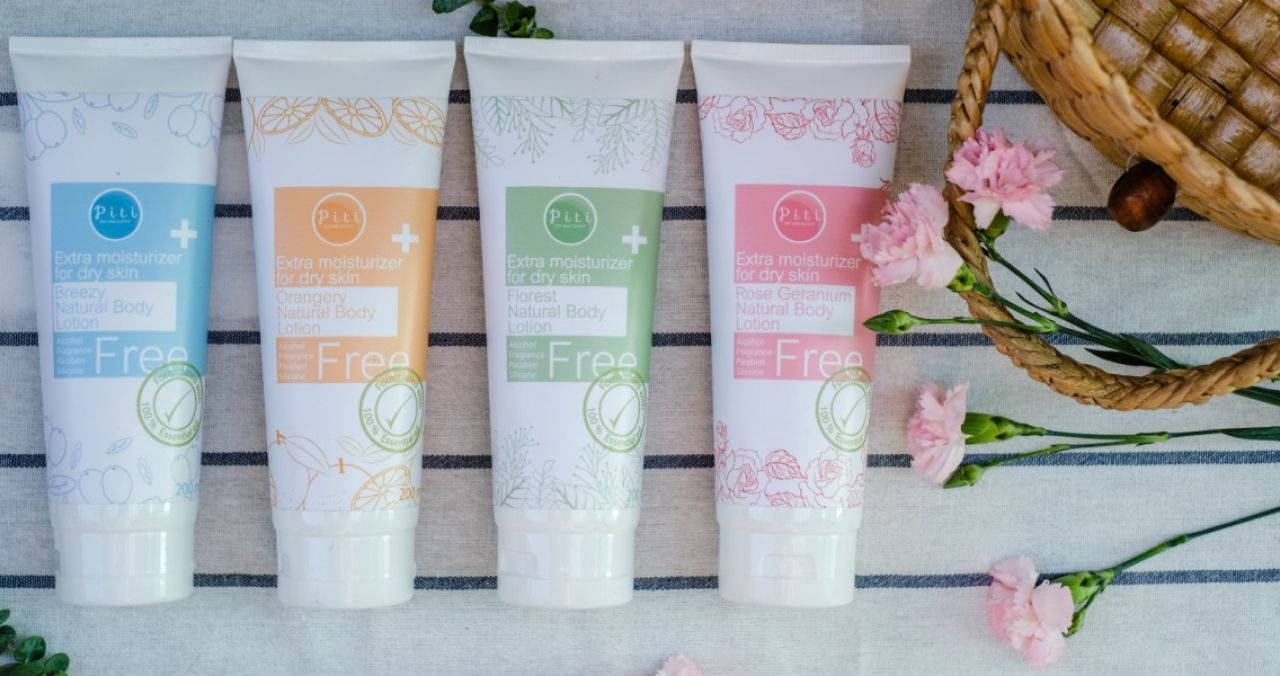
Piti’s lotion comes in 4 formulas.
Green: Florest scent; Blue: Breezy scent; Pink: Rose geranium scent; and Orange: Orangery scent. They come in pump bottles. When you first open a new bottle, it can be a bit hard to pump because the lotion is quite thick. With a fairly high amount of oils and fats in the formula, you get a thicker lotion texture—but that thickness is beneficial for coating and protecting the skin and keeping it moisturized for a long time. The scents of all 4 formulas differ according to their names.

Green (Florest scent) contains essential oils of Lavender, Ylang-ylang, and Geranium. It opens with the herbal tone of Geranium blended with Lavender, then softened with Ylang-ylang, giving a relaxing and refreshing feel.
Pink (Rose geranium scent) contains essential oil from Geranium, softened with the fragrance components Citronellol and Geraniol, which give a rose-like scent with a slightly green, herbal nuance, creating a relaxing feel.
Blue (Breezy scent) contains essential oils of Lavender, Lemongrass, and Peppermint, sweetened with the fragrance component Linalool, which has a floral scent. It’s a well-balanced essential-oil blend: it opens with the sweet-yet-tangy note of Lemongrass, followed by the cool, refreshing scent of Mint, with a soft floral nuance from Lavender and Linalool.

Orange (Orangery scent) contains essential oils of lime, orange, grapefruit, Lavender, Sandalwood, and ginger. It opens with a citrus-family scent, but not a sharp, overly sweet orange—more of an elegant citrus, cut with Lavender, the cool note of Sandalwood, and the warm note of ginger, becoming a distinctive signature blend. The lotion has a white, slightly thick, cream-like texture and smells fragrant according to the formula.

Even though the lotion looks thick, it spreads easily, doesn’t leave white patches on the skin, absorbs quickly, and isn’t sticky, but leaves a thin film that coats the skin to keep it soft and moisturized.
Regarding the pH value, it wasn’t measured today. The lotion contains quite a lot of oils, so the pH test paper didn’t get wet or change color at all. Let’s look at the ingredients instead. I’ll take my favorite formula, Breezy, and analyze the ingredients for you.
From today’s ingredients, I color-coded the skincare actives into 4 colors. You can see that most of the ingredients are natural oils and skin-conditioning agents, with fragrance from essential oils and naturally derived aromatic compounds. There are no ingredients that are unfriendly to the skin. For the skincare actives, let me start with:
Blue: Hydroxyethyl urea. This is a derivative of urea. It has good properties for boosting moisture, reducing flakiness from dryness, improving elasticity, and helping the skin feel smooth.
Purple: A group of natural oils, consisting of caprylic/capric triglycerides (a fat with relatively shorter chains) and four other plant oils: coconut, rice bran, olive, and shea butter.
Green: Skin-conditioning agents and plant extracts, of which there are several types, including evening primrose seed extract. Information from the raw material manufacturer states that it helps increase moisture and reduce inflammation and irritation.
The manufacturer states that it showed beneficial results in volunteers with symptoms of atopic dermatitis. Rehmannia Chinensis extract: an extract from the Chinese foxglove plant, a traditional herb that Japanese people have used as a topical medicine since ancient times. Information from the raw-material manufacturer indicates that it acts as a moisturizer, reduces inflammation and irritation, and helps soften the skin. Peach leaf extract.
The raw-material manufacturer states that the leaf extract is beneficial for anti-aging and reducing wrinkles. Phellodendron amurense bark extract: an extract from a plant used in a traditional Chinese medicine formula; there are reports regarding its anti-inflammatory properties (Int Immunopharmacol. 2014; 19(2):214-20.).
Information from the raw-material manufacturer indicates that it contains an alkaloid called berberine, which is beneficial for reducing inflammation, inhibiting microorganisms, and acting as an antioxidant. Algae extract: since there are many algae species, it is not possible to specify details; overall, algae are beneficial for increasing moisture and as antioxidants. Houttuynia cordata extract: information from the raw-material manufacturer indicates benefits in reducing inflammation/irritation and helping with skin repair.
Okra extract (Hibiscus esculentus fruit extract) contains polysaccharides that help increase moisture. Artichoke extract (Cynara scolymus leaf extract): information from the raw-material manufacturer indicates benefits in reducing inflammation/irritation and antimicrobial activity. Grapefruit extract (Citrus junos fruit extract) helps increase moisture and acts as an antioxidant. Tocopheryl acetate is a form of vitamin E; it is beneficial as an antioxidant, but likely helps protect the oils in the product from degradation. Biosaccharide gum-1: a carbohydrate obtained from microbial fermentation.
The raw-material manufacturer states that it can provide long-lasting skin moisturization. This ingredient forms a film, giving a moisturized, soft feel without stickiness or greasiness. Blue color: fragrance and essential oils, including the fragrance ingredient linalool with a sweet floral scent, together with essential oils from lavender, lemongrass, and peppermint, providing a refreshing and relaxing feeling.
In aromatherapy, it is also believed that these essential oils help nourish the skin, reduce inflammation and irritation, and support skin repair. The base is an emulsion base, consisting of water and oils, with both humectants, emollients, and lipid ingredients that coat and protect the skin.
It’s considered a well-rounded moisturizer lotion. Most importantly, it contains no silicone or alcohol, and no skin-unfriendly ingredients. Let’s score it.
The nourishing ingredients are a group of plant extracts, most of which are imported from abroad, focusing on reducing skin inflammation and irritation while also increasing moisture—one of the major issues for people with dry skin. It’s complemented with plant oils that help replenish lipids back into the skin.
As we age, the skin’s synthesis of barrier lipids decreases. Adding these is like helping the skin in another way. Plant oils also contain compounds like phytosterols, which provide additional benefits in reducing inflammation and irritation. Overall, it’s well made and suitable for dry skin and elderly skin—but you don’t have to wait until you’re older to use it. Kids and teens with dry-skin problems can use it too. Personally, I’m only in my early 30s and I still use it regularly—every morning after showering. For the nourishing ingredients, I give it 5 flasks.
Other ingredients: the base is an emulsion base. The texture is quite thick, matching the brand’s claim that it’s “the last stage of lotion before becoming a cream,” because it contains quite a lot of lipid ingredients, making it thick. But even though it’s thick, it still feels lightweight and doesn’t leave white streaks when applied. The base has no alcohol, no silicone, and no skin-unfriendly ingredients—5 flasks. Usage: when I first tried it, I secretly liked the Rose Geranium scent, but over time I ended up liking the Breezy scent more. Every scent is blended quite well and has its own character—like applying a quality perfume. Especially the Orangery scent, which is a blend of citrus notes (orange-family plants), ginger, lavender, and sandalwood—it's a scent that’s hard to find. Not to sound like I only like the fragrance—the lotion’s texture is also well done. However, on very cold days (there was one day in Chiang Rai when it was 8°C), the lotion is a bit harder to spread; you need to warm it in your hands for a while and let the heat help it melt before applying it to the body. Apply in the morning and the skin stays moisturized until evening; you don’t even need to shower at night (oops, gross lol) and can just sleep like that. It’s not sticky, not slippery, not slimy. As for whether it gets slippery or greasy when you sweat—I haven’t been sweating yet because it’s quite cool around my place lately; I’ll update again later. For usage score, I also give it 5 flasks.
Lastly, I would like to thank the Piti brand as well for sending great products for me to try, and thank you to everyone for watching until the end.
Read more on the Jeban website (click here).
Disclaimer/conflict of interests: This product was sponsored by the Piti brand. This review is an analysis of the ingredients based on principles of cosmetic science and is based on personal opinion. The author has no vested interest in selling the product. Please use your discretion.


